
Design for Reuse: Circular Façades with Rainscreen Systems
Introduction
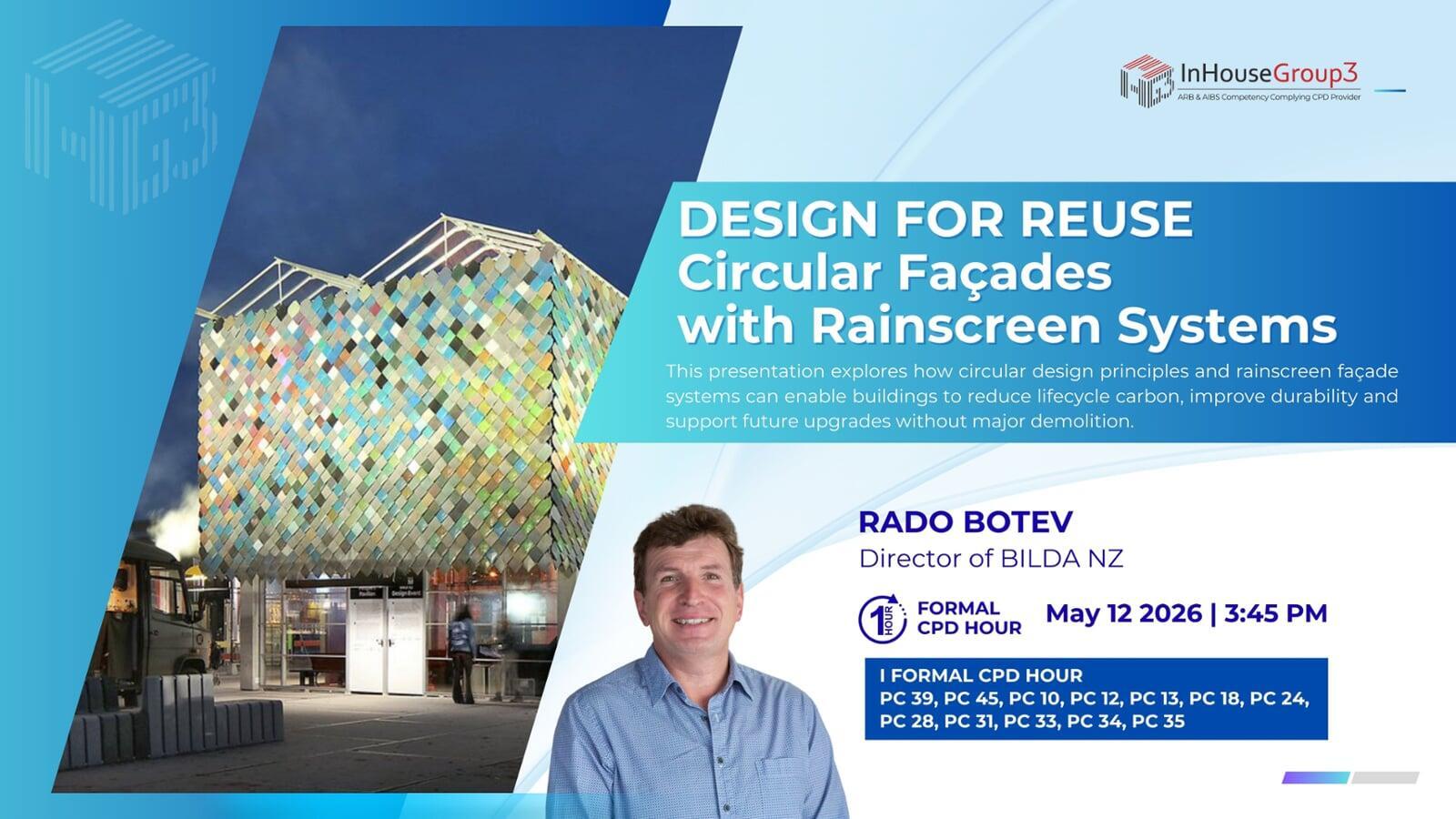
The construction industry faces increasing pressure to reduce carbon emissions, material waste and resource use. Façades often contain high-embodied-carbon materials and are commonly replaced every 20–30 years, creating significant environmental impact. This presentation explores how circular design principles and rainscreen façade systems can enable buildings to reduce lifecycle carbon, improve durability and support future upgrades without major demolition.
Summary
Design for reuse requires a coordinated approach from concept through detailing and documentation. By using modular grids, mechanical fixings, durable materials and BIM-based material tracking, façade systems can be designed to be repaired, adapted and reused rather than replaced. Rainscreen façades provide a practical pathway to achieve circularity while improving long-term building performance and sustainability.
Biography
BILDA NZ, established in 2023 in Auckland, NZ is the APAC Licensed Manufacturer and Agent for STOA Group of Companies. STOA Group, owner of the registered trademark BILDA, was established in 1990 in Bulgaria with a field of expertise in design, manufacture and supply of external envelopes – curtain walls and rainscreen facades.
For over 30 years BILDA facade system is under continues improvement and now has registered patents in Europe, USA, Middle East, Australia and NZ.
BILDA projects spans across Europe, USA, Canada, Kuwait, UAE, Middle East and since 2024 in NZ.
At the end of the presentation, attendees will be able to understand:
Understand the impact of facades on lifecycle carbon and energy
Explain circular façade design principles
Compare linear vs circular façade systems
Apply design-for-reuse methodologies in façade design
Recognize the sustainability benefits of reusable façade systems
Recognize how façade design contributes to embodied carbon, operational energy use, and construction waste in buildings.
Identify the key strategies of durability, disassembly, repairability, adaptability, and recyclability in façade systems
Understand why direct-fix cladding systems limit reuse, while rainscreen façades enable reversible and adaptable building envelopes.
Understand how concept planning, modular grid design, mechanical fixings, material selection, and BIM documentation enable future reuse.
Evaluate how reversible rainscreen façades can reduce embodied carbon, improve operational performance, and enable future upgrades such as BiPV integration.